
Analysts have largely maintained a bullish outlook on HDFC Bank and ICICI Bank following their Q4FY26 results, though their perspectives on future growth drivers differ. HDFC Bank's near-term performance is tied to accelerating loan growth, while ICICI Bank is seen as a strong candidate for a valuation rerating.
HDFC Bank, India's largest private-sector lender, has revised its FY27 growth trajectory, stepping back from earlier guidance to align with a more measured 12 per cent year-on-year expansion, citing geopolitical uncertainties.

India's private-sector banks are likely to lose market share for a second consecutive year in 2025-26, as their loan books continue to expand much slower than overall bank credit.

Banking sector has witnessed healthy growth in advances in the third quarter of financial year 2026 (Q3FY26) against the same period last year, as the full impact of goods and service tax (GST) rate cuts drove growth. Most of the lenders saw their credit growth outpace the deposit growth in the quarter.

The benchmark BSE Sensex's trailing 12-month price-to-earnings (P/E) multiple has declined to 20.2x, its lowest since May 2020, driven by a record $42 billion FPI selloff since September 2024 and concerns over corporate earnings and economic growth.

Private sector banks that announced their earnings for the October-December quarter (Q3) of 2024-25 (FY25) reported a rise in credit costs due to higher provisions, mainly for unsecured retail loans.

Bank lending to companies is expected to go up in the coming quarters because the difference in interest rates between corporate bonds and bank loans has narrowed. In addition, recent policy reforms by the Reserve Bank of India (RBI), including allowing domestic banks to do acquisition financing, are expected to give further support to corporate lending, analysts said.

There are hopes of a turnaround in overall corporate earnings after six quarters of single digit growth.

A US-sanctioned tanker carrying Iranian crude oil has rerouted mid-voyage from its previously indicated destination of India to China, raising questions about payment issues and the future of India's Iranian oil imports.

The uncertain macroeconomic environment may have prompted HDFC Bank to go slow on expanding its credit card portfolio.

Non-banking financial companies (NBFCs) such as Bajaj Finance, Shriram Finance, Muthoot Finance, and IIFL Finance have regained their growth momentum after losing market share to banks in the post-Covid period. The growth surge is being led by diversified lenders and gold-loan companies while development-finance institutions such as Power Finance Corporation (PFC), REC, and Housing & Urban Development Corporation (Hudco) continue to grow at a slower pace.

Households should moderate large discretionary expenses for the time being.
'They should prioritise essential spending. They should maintain an emergency fund covering 6 to 12 months of expenses.'

The easing of external commercial borrowing (ECB) norms by the Reserve Bank of India (RBI) is expected to significantly boost overseas fundraising by Indian companies, market participants said.

Sanjay Malhotra has made structural changes to banking regulation to bring down costs and increase efficiency. Plus, he kicked off a benign interest regime. But there are challenges ahead.
Axis Bank reported a sharp drop in net profit in the second quarter of financial year 2026 (Q2FY26) on higher provisions and weak operating profit growth while revenue growth was moderate. But loan growth and deposit growth improved to double-digits year-on-year (Y-o-Y) and asset quality also improved with the gross non-performing loan or NPL ratio moving down.
The core dilemma remains: Why provide further stimulus to an economy that is already booming at an 8 per cent growth rate? asks Rajeswari Sengupta.

Credit quality of Indian corporate is expected to be stable in the second half of the current financial year (H2FY26), supported by easing monetary cycle, and declining inflation, coupled with income-tax relief and rationalisation of the goods and service tax (GST) rates, among others.

Indian corporate are increasingly shifting away from bank funding towards alternative sources, such as equity and bond markets, as their deleveraged balance sheets have improved their ability to raise equity at better valuations. Moreover, the 100 basis points (bps) rate cut by the Reserve Bank of India (RBI) has enabled them to access long-term funds from the debt capital market at cheaper rates.

After two years of strong gains, smallcap stocks fell sharply in 2025, but the correction may be setting up opportunities for long-term investors.
Analysts have largely maintained their positive outlook on HDFC Bank, as the private lender reported in-line results for the October-December quarter (Q3) of the current financial year (2024-25/FY25). They believe the results were 'strong' given the tough macro environment, and relative to peers.
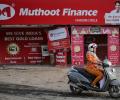
Shares of gold finance companies Muthoot Finance and Manappuram Finance hit their respective all-time highs, gaining on the BSE during Wednesday on expectation of healthy earnings. In comparison, the benchmark BSE Sensex was down 0.14 per cent, closing at 85,408.

The forthcoming Budget could think of maintaining public capital expenditure at 3 per cent so that domestic resources are available for private investments, points out N R Bhanumurthy.

Despite his influence, Pratik Jain avoids the spotlight. Credit is routinely passed on to colleagues. He maintains no visible faction within the TMC, no personal coterie.

Bajaj Finance's shares fell more than 7 per cent on Tuesday after it trimmed growth guidance for FY26, from 24-25 per cent projected earlier to 22-23 per cent.

With rising credit demand, cleaner balance sheets, and renewed investor confidence, banks are positioned at the forefront of the market rally. From major players like ICICI and HDFC to broader policy shifts, there's much driving this momentum.
With rising credit demand, cleaner balance sheets, and renewed investor confidence, banks are positioned at the forefront of the market rally. From major players like ICICI and HDFC to broader policy shifts, there's much driving this momentum.
With rising credit demand, cleaner balance sheets, and renewed investor confidence, banks are positioned at the forefront of the market rally. From major players like ICICI and HDFC to broader policy shifts, there's much driving this momentum.
Defying the bearish sentiment in the markets on Monday, ICICI Bank's share price rose by 2 per cent, reaching an intraday high of Rs 1,234.4 per share on the BSE. With a 1.5 per cent gain at the close, the stock emerged as the top performer on both the BSE Sensex and the National Stock Exchange Nifty 50 indices.

The Reserve Bank of India's (RBI's) draft guidelines on gold loans, if implemented in their current form, are expected to impact non-banking financial companies (NBFCs) and mid-tier banks in the near term, more significantly than larger banks, according to analysts.

After a year of modest returns, equity investors may anticipate gains of 10-15 per cent in Samvat 2082, which began on October 21. Although valuations have moderated from their peaks a year earlier, they remain above long-term averages, potentially limiting sharp upsides.

The Adani group, which operates across multiple infrastructure sectors, with 12 listed entities in India and a combined market capitalisation of about $200 billion, remains "anchored by strong assets and robust cash flows", according to a Bank of America (BofA) report.

While the DMK depends on a 'silver sieve' of welfare schemes to stay in power, its support is slowly draining away under the weight of poor governance, corruption, and voters who are no longer satisfied with benefits alone and now want basic administration to work, observes N Sathiya Moorthy.

Shares of state-owned bank stocks were under pressure on Monday due to muted deposit and credit growth numbers reported by these lenders in the October-December quarter (Q3) of 2024-25 (FY25). The Nifty PSU Bank index was down 4 per cent, with Union Bank of India emerging as the biggest loser as its shares fell 7.5 per cent to close at Rs 114.7, followed by a 5.7 per cent drop in shares of Bank of Baroda (BoB) to Rs 228 and a 4.7 per cent slide in shares of Bank of India to Rs 99.8 on the National Stock Exchange.

Net profit of 19 listed banks is likely to decline by 4 per cent year-on-year (Y-o-Y) for the quarter ended March (Q4FY25) mainly due to pressure on net interest margins (NIM) as a result of rate cut by the Reserve Bank of India (RBI), according to analysts' estimates. Additionally, loan growth is expected to further slowdown amid low demand in certain secured products, stress in the unsecured segment, and a high cost to deposit (CD) ratio across the system.

With high credit growth and healthy asset quality, listed commercial banks are expected to report steady growth in earnings during the fourth quarter ended March 2024 (Q4 FY24). Profits are expected to grow at 9.6 per cent year-on-year (Y-o-Y) and net interest income (NII) by 8.7 per cent in Q4 FY24, according to Bloomberg analysts' estimates. According to Motilal Oswal Securities, while bank credit growth has been robust, deposit growth has also gathered pace.
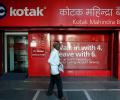
Kotak Mahindra Bank's net interest margin is likely to swell after the Reserve Bank of India (RBI) lifted its restrictions on the private lender that barred it from issuing fresh credit cards and onboarding new customers through digital mode, brokerages said on Thursday. The bank's net interest margin (NIM) has seen a decline of over 35 basis points (bps) since the restrictions were imposed by the regulator in April 2024.

The sector's IPO pipeline is led by Tata Capital's Rs 17,000 crore issue, followed by ICICI Prudential Asset Management at Rs 10,200 crore and Billionbrains Garage Ventures at Rs 6,000 crore.

Voters are weighing a stark trade-off -- between preserving a socially driven policy and reversing course to revive revenue, restore fiscal balance, and rein in the underground liquor economy.

The stock of State Bank of India (SBI) may re-rate soon, believe analysts, if the lender manages to safeguard its net interest margin (NIM) going ahead. This, along with controlled credit costs, should aid the outlook of the stock which has been underperforming the markets for some time now. "We believe delivery of growth on guided lines, sustenance of NIMs near current levels, and controlled asset quality parameters aiding controlled credit costs should lead to strong profitability and drive re-rating of the stock," said analysts at JM Financial.

New investors should not allow themselves to fall prey to FOMO and rush headlong into gold.
 © 2026 Rediff.com - Advertise with us - Disclaimer - Privacy Policy - Sitemap - Feedback - About us - Terms of use - Grievances